H5 Bird Flu and Australia's Maritime Biosecurity: An Emerging Risk for Imported Cargo


H5 Bird Flu and Australia's Maritime Biosecurity: An Emerging Risk for Imported Cargo
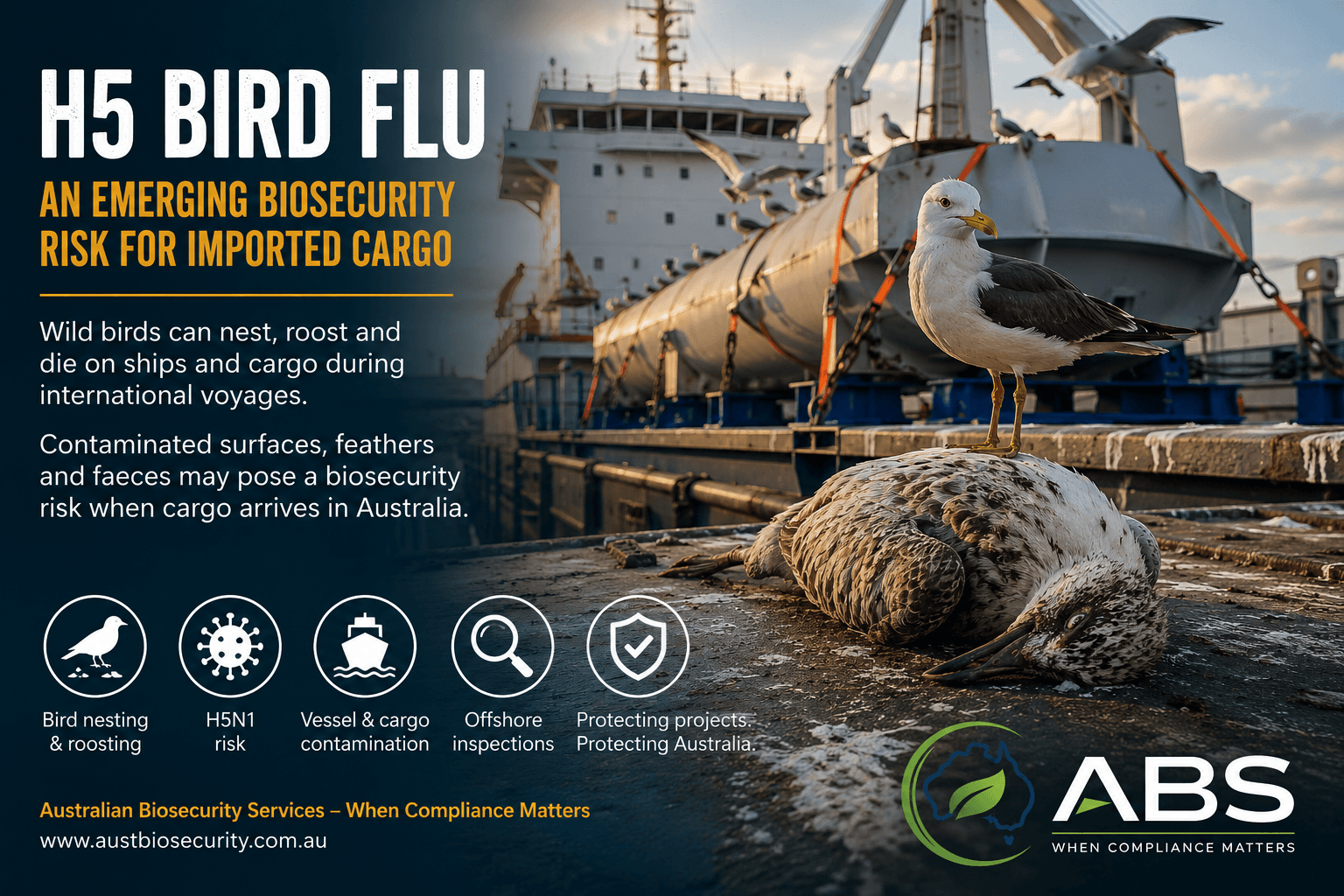
Australia's biosecurity system has long been recognised as one of the strongest in the world. However, the recent arrival of Highly Pathogenic Avian Influenza (HPAI) H5N1 in wild birds within Australia has introduced a new and evolving challenge for importers, shipping companies, port operators and project owners.
While much of the public discussion has focused on impacts to wildlife and the poultry industry, there is another important pathway that deserves greater attention—the international maritime supply chain.
Ships Can Become Unintentional Vectors
Cargo vessels spend days or weeks travelling between international ports before arriving in Australia. During these voyages it is common for seabirds to:
Land and roost on vessel superstructures
Nest on sheltered areas of ships
Rest on large items of deck cargo
Become trapped within cargo or equipment
Die onboard during the voyage
If infected birds are present, they can contaminate vessels and cargo with faeces, feathers, nesting material or carcasses. These contaminated surfaces may represent a biosecurity concern that requires careful assessment before cargo is discharged. While the virus does not survive indefinitely in the environment, it can persist for varying periods depending on temperature, moisture, sunlight and the type of surface involved.
Large Project Cargo Presents Additional Challenges
Unlike containerised freight, oversized project cargo often remains exposed on deck for extended periods during international voyages.
Examples include:
Wind turbine components
Mining equipment
Modular buildings
Industrial plant and machinery
Oil and gas infrastructure
Defence equipment
Large steel fabrications
These cargoes provide attractive resting locations for seabirds throughout a voyage. By the time a vessel arrives in Australia, contamination may not be immediately obvious without a detailed biosecurity inspection.
In some cases, inspectors may encounter:
Bird droppings on cargo surfaces
Feathers or nesting material
Dead birds lodged within equipment
Areas contaminated beneath roosting locations
Each finding requires an appropriate biosecurity assessment to determine the level of risk and any required management actions.
Why Early Detection Matters
Discovering bird contamination after cargo has been discharged can create significant operational impacts.
Depending on the circumstances, authorities may require:
Further inspection of the vessel or cargo
Cleaning or decontamination
Controlled disposal of bird carcasses or nesting material
Temporary delays to cargo release while assessments are undertaken
For major infrastructure projects where delivery schedules are tightly coordinated, even short delays can have substantial commercial consequences.
Planning for these risks before the vessel arrives is becoming increasingly important.
Offshore Biosecurity Inspections Are Becoming More Valuable
One of the most effective ways to manage maritime biosecurity risk is to identify potential issues before the vessel reaches Australia.
Pre-arrival or offshore inspections can help identify:
Active bird roosting areas
Evidence of nesting
Bird carcasses
Contaminated cargo surfaces
Vessel areas requiring cleaning before arrival
Where issues are identified early, corrective actions may be possible before entering Australian waters, reducing the likelihood of delays during import clearance.
This proactive approach has long been used for managing other biosecurity risks, including invasive insects, soil contamination and hitchhiker pests, and may become increasingly important as H5 bird flu establishes itself within the region.
Biosecurity Is About More Than Customs Clearance
Importers often focus on customs documentation and logistics planning, but biosecurity risks can develop at any point during an international voyage.
Cargo that departed an overseas port in excellent condition may arrive with entirely new biosecurity concerns that developed while at sea.
As Australia's biosecurity environment continues to evolve, importers should consider maritime biosecurity as part of their overall supply chain risk management—not simply as a regulatory requirement, but as a practical way to protect project schedules, reduce delays and maintain compliance.
How Australian Biosecurity Services Can Help
Australian Biosecurity Services works with importers, project owners, EPC contractors, freight forwarders and logistics providers to identify and manage biosecurity risks before they become costly problems.
Our services include:
Offshore vessel and cargo inspections
Biosecurity risk assessments
Biosecurity Management Plans
Imported cargo inspections
Supplier assurance programs
Pre-arrival compliance advice
Biosecurity support for major infrastructure and renewable energy projects
With decades of operational experience across Australia's biosecurity system, we help clients manage complex import pathways while maintaining compliance with Australian biosecurity requirements.
Need advice before your next shipment arrives?
If your project involves international breakbulk cargo, heavy machinery, modules or oversized freight, speak with Australian Biosecurity Services early in your planning process. Identifying potential risks before a vessel berths is often the simplest—and most cost-effective—way to avoid unnecessary delays.
Australian Biosecurity Services Pty Ltd
When Compliance Matters